Waldzell
The Glass Bead GameWaldzell is the smallest and most artistically oriented of the Castalian elite schools, but its influence reaches far beyond its classrooms: the town also houses the official institutions of the Glass Bead Game. For Joseph Knecht, it is first an entrancing new home and the arena of his formative friendship with Plinio Designori; later it becomes the center of his professional distinction, and finally a world he recognizes he has outgrown. Its history traces the attraction and limits of a culture that seeks to unite scholarship, art, and spiritual ceremony within a protected community.
School and setting
Among the second- and third-level Castalian schools, Waldzell is distinguished by its devotion to the arts and by its traditional effort to join scholarship with artistic practice. Other schools are associated with particular disciplines, while Waldzell cultivates universality. The Glass Bead Game is the highest symbol of that ambition, though it is not officially taught as a compulsory subject. Students instead devote much of their private study to it.
The school itself is separate from the Game’s official institutions, yet both occupy the same town and share an atmosphere. Waldzell contains the ceremonial Game Hall, the extensive Game Archives and their libraries and administration, and the residence of the Ludi Magister. The institutions’ solemn public culture permeates the school even without formal administrative attachment. Townspeople call the students scholars and refer to those attending the Game School as “lusers,” a local corruption of lusores.
Waldzell’s small size adds to its aura of distinction: its student body rarely exceeds sixty. In recent decades it has produced many Masters and most Glass Bead Game players, and admission or transfer there carries prestige. That prestige also attracts resentment. Critics dismiss Waldzellers as priggish aesthetes or pampered princes, supposedly useful for little beyond the Game; the sharpness of the schools’ jokes, the narrator observes, reflects jealousy as well as criticism.
Knecht’s arrival and the school’s social world
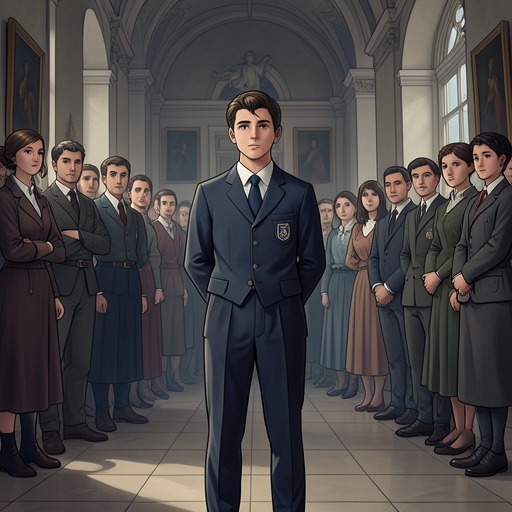
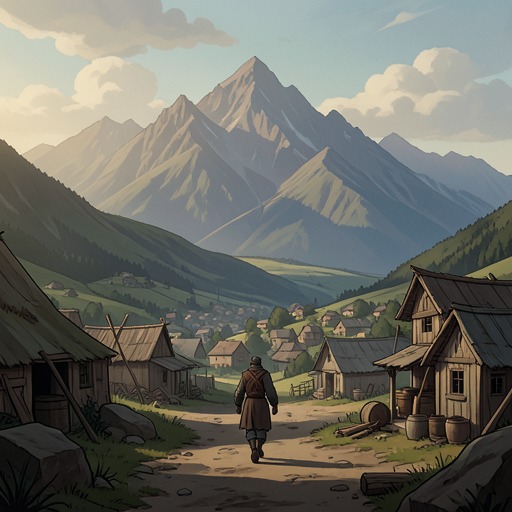
When Knecht arrives with several schoolmates, he enters through the southern gate and is immediately captivated by the town’s dark-brown appearance and the massive former Cistercian monastery that houses the school. Before receiving his uniform, he sets out alone from the porter’s lodge to explore. He follows the path along the old town wall above the river, pauses on the arched bridge to listen to the millrace, passes the graveyard and a lane of linden trees, and recognizes the nearby Vicus Lusorum beyond its tall hedges. Waldzell first presents itself to him not as a curriculum but as a landscape in which school, history, and Game culture meet.
The headmaster, Otto Zbinden, is nearing sixty when Knecht arrives. He is an unusual, somewhat eccentric figure who inspires fear, and his handsome, impetuous handwriting appears in many documents concerning Knecht. Yet at first the new pupil’s attention is drawn less to the teachers than to his classmates. Among them is Carlo Ferromonte, to whom Knecht becomes attached during his first months at Waldzell. Ferromonte later rises to the second-highest rank on the Board as deputy to the Music Master and writes a history of sixteenth-century lute styles, a later career that illustrates the school’s capacity to turn youthful study into service to Castalian institutions.
Another consequential presence is Plinio Designori, a hospitant: a guest pupil who attends an elite school without intending to remain in the Pedagogic Province or enter the Order. Such students are rare because the Board of Educators is reluctant to educate boys who will return to the outside world. Some old patrician families, however, retain the custom of sending one son to study as a guest, in recognition of their families’ services to Castalia at its foundation. Designori’s status therefore gives the school a direct, if unusual, connection to the world beyond its protected educational system.
Friendship, contest, and the Glass Bead Game
Knecht and Designori’s friendship develops as a sustained contest between contrasting principles. During the two or three years they remain friends at school, their disputations become a drama watched by the whole community, from the headmaster to the youngest freshman. Each encounter stimulates the other: Designori brings energy from his holiday visits to his native soil, while Knecht returns from reflection, reading, meditation, and meetings with the Magister Musicae newly equipped to represent Castalia. Their opposition is not merely private; the students experience each debate as a solemn, symbolic contest involving the school as a whole. One especially remarkable joust leaves a lasting impression on its witnesses and helps establish a new, more lucid and relaxed relationship between Knecht and Zbinden, though it does not resemble the affection and mystery of Knecht’s bond with the Music Master.
The Game’s place in Waldzell is at once intellectual discipline and public ceremony. Its official institutions are distinct from the school, but the town’s identity and the students’ private studies are interwoven with it. The wider culture of the Game likewise draws on materials that do not belong exclusively to Castalia: Christian theological language can enter its symbolic system alongside mathematical axioms or Mozart’s melodies. The Game can function for dedicated players almost as worship, although it deliberately develops no theology of its own. In the Feuilletonistic Age, it was even called the Magic Theater, a name that captured its aspiration to gather separate intellectual and artistic elements into a single experience.
That ceremonial dimension is especially visible in the annual public Game. The older era of Games lasting weeks and drawing dignitaries from around the world has passed, but the spring Ludus anniversarius remains a major Castalian festival. Its principal solemn Game usually lasts ten days to two weeks. By bringing together different tendencies within the Province, it symbolically reconciles disciplines whose ambitions might otherwise conflict. For believers it has the force of consecration; for those without belief it can serve as a substitute for religion and, for both, as an experience of beauty. The account compares this shared ceremonial function with the reception of Bach’s Passions after their rediscovery: a work of art can become worship for some and a religious substitute for others without losing its artistic character.
Recognition and return
After his apprenticeship with Elder Brother, Knecht overcomes his earlier resistance to returning to Waldzell. He begins attending an advanced course there each year and gradually becomes a figure of interest and esteem in the Vicus Lusorum. He enters the anonymous group of proven players whose members help determine the Game’s direction. This standing grows through participation rather than a simple return to his former student identity: Waldzell becomes the place where his developing vocation is recognized within the Game’s central community.
During his later service at Mariafels, Knecht competes again in Waldzell’s annual elite contest after abstaining for two years. Entrants devise Game sketches around three or four prescribed main themes. The work is judged for bold and original associations, logical rigor, and beautiful calligraphy; only in this competition may participants go beyond the canon by proposing symbols not yet admitted to the official hieroglyphic code. The contest thus tests both mastery of inherited rules and the ability to extend them. Knecht submits a restrained, elegant, and solid composition, expecting at most an honorable mention or a lesser prize. From his guest room in the monastery, he listens by radio to the announcement in the Vicus Lusorum’s Festival Hall and is surprised to hear that he has won first prize; Fritz Tegularius receives second. The result publicly confirms a distinction that Knecht had not sought to advertise.
His return also renews an old friendship under changed conditions. Years after their schooldays, Designori appears at Waldzell as a government official who has finished his university studies in the outside world and comes for a short guest course in the Game. The reunion exposes how far their lives have diverged: Designori is now an amateur entering a world Knecht knows professionally, while Knecht is treated as an initiate whose courtesy cannot disguise the imbalance. When Knecht asks about Designori’s official life, the roles reverse, and Knecht becomes the outsider asking innocent questions. Waldzell, once their shared school, now makes their different forms of knowledge and experience newly visible.
Several months later Designori accepts Knecht’s repeated invitation to visit. They travel through an autumn countryside of alternating light and shade, then walk the old paths of their schooldays, recalling former classmates, teachers, and their youthful discussions. Designori remains Knecht’s guest for a day and observes his official work. The return links the landscape to the friendship’s past without restoring the old equality: Waldzell can renew memory, but it cannot erase the distance created by their separate lives.
Departure and significance
As Knecht prepares to leave Castalia, Waldzell changes from a place of promise into a place of parting. During his final preparations he hurries through the Vicus Lusorum, checks its arrangements, and secretly trains the Shadow who will soon have to represent him. Yet the care of these duties no longer means inward allegiance. Knecht recognizes that he has already liberated himself from the carefully ordered world of the Game; Waldzell and his magisterial office belong to a completed stage that gave him much but can no longer call forth new effort.
On his last nocturnal walk through the deserted corridors and courtyards, his seriousness returns. The scene recalls his first exploration as a boy, when hope and apprehension accompanied his arrival. Now he notices the silent Players’ Village, the small light above the gatekeeper’s lodge reflected in the fountain basin, and the clouds moving over the trees in the Magister’s garden with the knowledge that he will not see them again as their resident. The remembered arrival and the present leave-taking give Waldzell’s familiar paths a double meaning: they have carried Knecht into his Castalian life and now mark its end.
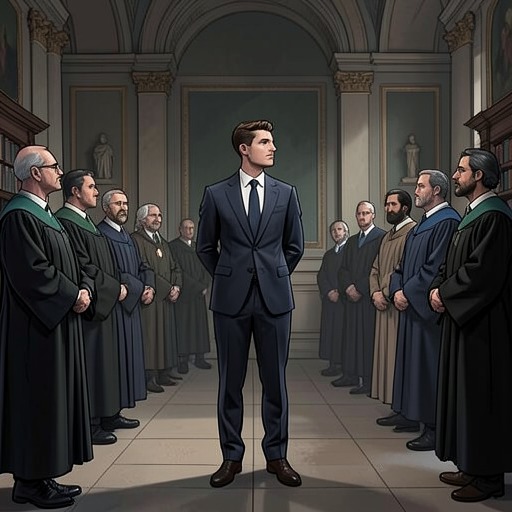
Knecht leaves the Vicus Lusorum permanently, returns the Magister’s seals and keys intact, and tells the representative of the Board that the village’s affairs are in order. His resignation is extraordinary but not a formal violation of the rules. That distinction matters: Waldzell and the Castalian hierarchy bind their members through powerful unwritten loyalties, yet the written regulations do not make departure illegal. The institution’s gravity is therefore moral and communal as well as administrative. Knecht’s decision cannot be settled simply by invoking procedure, and the seriousness with which he hands back his insignia makes the separation a deliberate relinquishment rather than a disorderly escape.
Waldzell’s significance lies in this double role. It is a school that prizes universality and artistic cultivation, a town shaped by the ceremonial authority of the Glass Bead Game, and a community capable of recognizing Knecht’s gifts. It also embodies the enclosed Castalian life from which he eventually needs to turn. Looking back, Knecht describes Designori as having brought fresh air into his quietude and reconnected him with the outside world; that contact helped him admit that his career in Castalia had reached its end. Waldzell remains the place where his calling was formed and honored, but its most decisive lesson is that a completed stage must sometimes be left behind.